How children use their gestures to better understand and represent things
Preschoolers use gestures to aid understanding and communication due to their limited vocabulary. Research highlights how these gestures play a crucial role…

Key points:
- Preschoolers use gestures to aid understanding and communication due to their limited vocabulary.
- Research highlights how these gestures play a crucial role in children's learning and problem-solving.
- Observing a child's gestures provides insight into their cognitive development.
- Susan Goldin-Meadow's work underscores the importance of gestures in children's learning.
Children around 3 and 4 years of age still have a very limited vocabulary, so their explanations and other cognitive features can’t be really understood by what they say. The question of whether young children comprehend more than what they can express with words, is something that has both intrigued cognitive scientist and perplexed parents. Because of this, today we synthesize vast literature on how children’s gestures provide insight into their cognitive state, their process of learning, and how they represent things beyond words.
In 1986, Susan Goldin-Meadow and her colleagues from the Department of Psychology of the University of Chicago discovered that the gestures and movements that preschoolers do in problem-solving situations or while understanding mathematical, abstract, or conceptual thinking are correlated with their efficacy and skill at the task. In other words, children use body movements to better understand new things. Drawing from numerous studies and experiments, they state that children’s spontaneous gestures help them work through something they haven’t mastered yet Also, they are the mechanism they use to point out to adults and caregivers the things they are understanding without only relying on their vocabulary. This allows the adults to better communicate with a kid at a given moment of a task, and also helps the child avoid the frustration of not being able to convey something.
More recently, Karen Pine and researchers from the University of Hertford discovered that children know more things than what they can actually express in words, especially regarding knowledge that is implicit or coded in spatial or visual formats. For example, how to solve problems, or the physical skills or concepts related to balance and speed. Research has shown that experienced coders can reliably “translate” the meaning of the gestures that children produce naturally when they express something they learned or when they’re solving a problem.
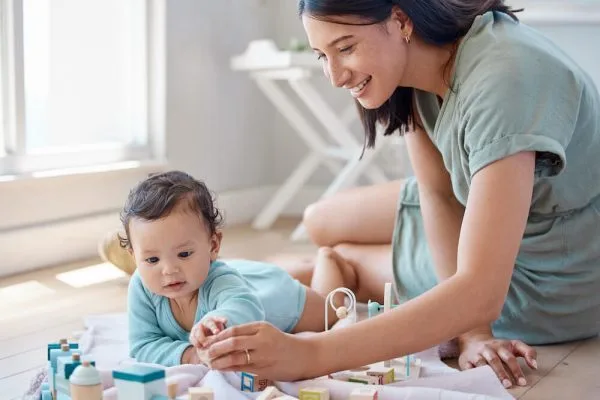
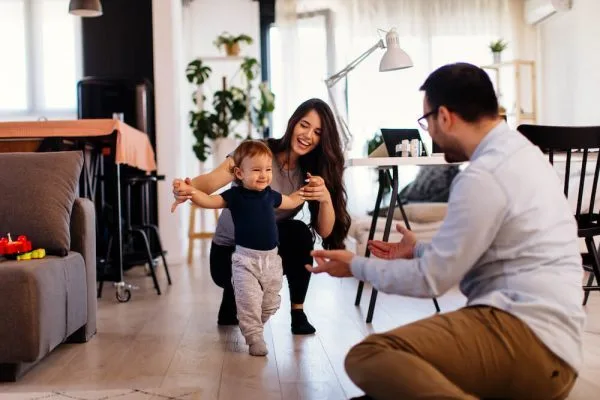
Next time you watch your child playing or doing a task, try to notice the hand gestures and body movements that they do knowing that they are in the middle of learning something new or consolidating something by themselves.